Variational Inference as a Gradient Flow in a Kernelised Wasserstein Geometry
Variational Inference (VI) optimises a training objective with gradient descent to infer optimal parameters in a parametric family of distributions — for example, to compute an approximate Bayesian posterior.
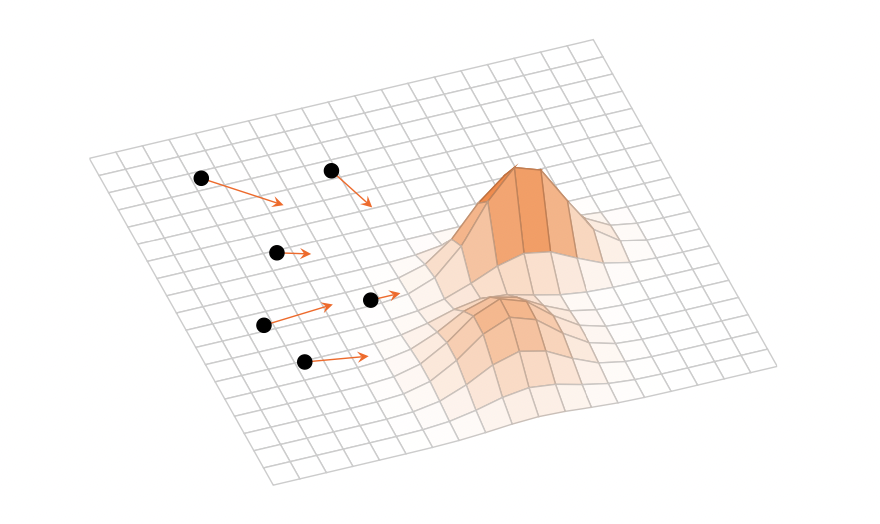
For my Master’s thesis, I formulated the training dynamics of variational inference as a gradient flow in a kernelised Wasserstein geometry. This builds on foundational results from two directions:
- The geometry of Stein operators and their induced kernelised geometry
- The relationship between gradient flows and black-box variational inference
Key Ideas
- Reformulating VI optimisation as a continuous-time gradient flow in a function space
- Using kernel-induced geometries (Stein geometry) to define the flow
- Connecting particle-based and parametric VI methods under a unified geometric framework
Context
This work was my Master’s thesis and explores the theoretical foundations of why gradient-based variational inference converges, and what geometry underlies its dynamics.